


🆕 Personal Updates
I’ve been going back and forth on my opinion on using AI for writing this newsletter. One minute, I want to avoid all use of AI to protect my ability to write in the future, my general writing integrity, and also the fact that you, as the reader, know this is human amongst the ever-growing amount of AI slop.
Then there are days when I think AI will be as normal as using a tool such as Grammarly on my writing, and people honestly don’t care if I use AI or not.
Currently, I’m leaning more towards the former; however, after watching this live stream with Dan Shipper working with Codex’s new AI voice model, it’s shifted my opinion that there is a blended option where it truly is acting as an assistant and sounding board rather than directly contributing to the writing itself.
And for those of you using the Substack app for web to read this issue, you can now validate my % of AI use to create this issue. And I promise I didn’t hack it!
Right, let’s get to it - time for this month’s roundup 👇
🔥 Last edition’s top clicked link: Pool - save everything and anything
🔗 Hyperlinks
Pablo’s new website
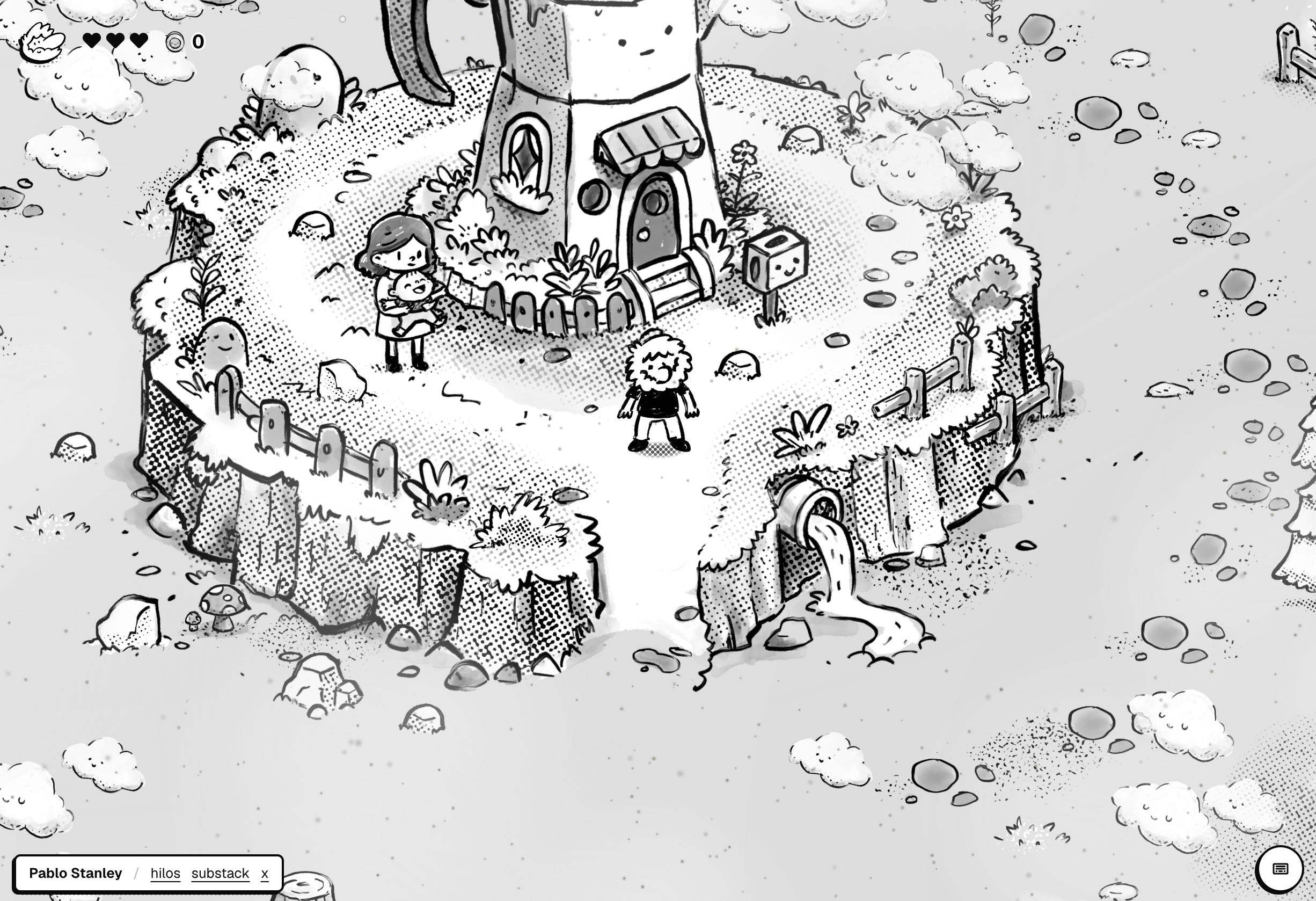
Gamified personal websites are coming back into vogue. I’ve seen a bunch in the last couple of weeks, all of which are entirely AI-generated.
But not this one. This one is hand-drawn. Pablo could have used AI, but he didn’t. He clearly loves his craft too much.
I’ve spent way too long playing around with this website - there is so much to see, and his humour is littered across the interactions you have with its characters.
Personally, I say bring back personal websites like these. While they don’t have great web performance, they aren’t great at converting visitors, and some folk will likely dislike them, they are full of creative fun.
Keep your eyes peeled for Pablo releasing the tool he built to create this very website.
🎁 Bonus content: Talking of personal websites, check this unique approach from Justin Rands.
European Technology Network
Finally, we have some economic and technological optimism coming to the home of summer holidays - Europe! While the reality might not be as rosy, the optimism is! ETN boys have taken the TBPN podcast format from the brothers across the Atlantic and brought it back to its new home in London, and after a healthy $1.6m seed round, they are moving from 3 days to a 5-day live broadcast.
The boys have big shoes to fill and are clearly still finding their groove; however, Europe was crying out for a fresh approach to tech media, given past attempts which have since shuttered or failed to make it into the daily tech discourse, like TechCrunch Europe and Sifted. Bring on the European tech optimism!
📓 Articles
Letters to a young creator
Ironically, the older I’ve gotten, the more I seek and appreciate good advice from people with first-hand experience. Naively, when younger, I assumed I could figure most things myself.
Letters to a Young Creator is a collection of;
… honest perspectives on what it takes to make something great, written by people who have done it before.
The digital letters are brief but full of wisdom from some of the most seasoned and successful scientists, designers, entrepreneurs, investors and creators in our generation. So far I’ve read Ed Catmull, Alan Kay, Arthur Rock and Tim Cook Apple.
One of the standout and super relevant quotes I’ve been thinking over comes from Alan Kay (legendary computer scientist):
… it is a duty of being a creator living in a society to help the society understand the implications of new creations.
What Alan’s implying is that just making something is only part of the job. Helping people to grasp how to live with the new innovation is a non-optional responsibility. My hunch is that with Alan’s suite of innovations he personally brought into the world, as well as the countless innovations he inspired, looking back he perhaps wishes he had educated society better on how to use them and how not to use them. Easy to say in hindsight, I guess, but that’s what these letters are for, right?
Perhaps the frontier AI companies could consider such a duty of care.
Notes on building products people love when software gets cheap
Hiten is back with another banger. This time, it’s a topic that’s top of mind for product managers (like myself) and is intertwined with a similar concern to software engineers and product designers alike:
Eventually “can we build this?” becomes a pretty boring question for a lot of software. Then we are left with the question that has always been harder anyway.
Should we build it?
I’ve felt this both firsthand professionally and personally. In fact, dare I say I’m experiencing it more with my personal projects. For years I’ve maintained a huge list of ideas in Notion. I randomly throw ideas for products and businesses I want to explore, but typically they require software in some shape of form to enable. This has been my excuse in the past and why, for the most part, they have remained just a few sentences in a long list of ideas. But what’s my excuse now? I’ve got the means to create a lot of them now, but I don’t.
That shift from “can we build this?” to “Should we build this?” seems like a nice luxury to have, and it is. But it requires a fundamental shift in how we validate and prioritise software development.
And this is where, as Hiten states, “things get interesting”. As building gets cheap and judgment becomes expensive, knowing when to build or not build becomes the real skill. This might explain why my Notion list is still a list - building was never the hard part.
You are the exit liquidity, in five convenient installments
I’ve sunk enough money into Claude subscriptions and AI wrappers this year that this piece landed like a gut punch. It opens with an old joke about a bloke who sells ten-dollar bills for five dollars each and insists business is booming; he just needs more volume. That, the author argues, is basically the entire AI industry’s balance sheet right now.
Unlike SaaS revenue, which can scale while the cost to serve it decreases and margins rise to heaven, AI doesn’t, as it stands. As queries burn compute, so do the revenue and the cost.
Then we have some particularly worrying financing happening right now, right down the AI stack. What many refer to as “circular financing”. For example, The Chip maker invests billions in the model company. The model company buys the chips back from the chip maker. Then the cloud provider signs contracts with the model company, which completes the financing circle. So basically, no outside financing is required! Does it seem right, does it? Yet the valuation loop continues to go up and up for all parties involved.
It is a group of friends standing in a circle, each handing the next one a ten dollar bill, like the three stooges, all of them now feeling considerably richer.
The worrying part of this post is the five quiet ways ordinary folks could end up footing the bill at the end of the day. But none of this is to suggest AI isn’t providing value or will continue to. But if we take both the railroad and dot-com internet infrastructure build-out, which were also huge innovations in history, they still managed to bankrupt the people who funded them, and it might not be the companies or investors themselves who take the brunt of the hit when the music stops.
🆕 Products
Codex Micro

It’s not just confusing new models that OpenAI is releasing; they’ve turned their hand to hardware. Well, kind of. It’s a collaboration with WorkLouder. The slick-looking programmable keyboards I’ve shared in previous issues.
The Codex Micro is a programmable macropad specifically to control OpenAI agents. It has six slick frosted keys that each follow a chat and light up with a live RGB status, a dial to crank up the reasoning effort, and programmable command keys to manage specific agent actions and Codex features. Does anyone need it? Absolutely not, and the price is pretty eye-watering, with some shipping fees to Europe coming in at £70, but it’s dam nice and looks pretty fun to use when orchestrating multiple agents in parallel.
But, as the tight and curious Scot I am, I’m attempting to programme my own using an off-the-shelf macropad I found on Amazon. Additionally, I’ve also managed to create a similar solution with my old personal 2020 MacBook Pro Touch Bar and the results are pretty wild. I might package this up on GitHub once it’s finished.
However, that’s not all. It seems high-end merch is hot in the valley. Following Palantir’s new clothing drop, OpenAI has also launched a line of clothing for all you fan boys and gals. I say that, but it’s actually pretty cool stuff.
SidePulse
While we are on the topic of fancy hardware gizmos for AI agents, I found this genius little product that slots into your likely redundant SD card reader.
You know that little slot they brought back in the new gen of MacBook Pros, which only 1% of users actually use - yeah, that one.
Well, now you can insert a small RGB chip that lights up to notify you of your agent’s status. Way cheaper than the Codex Micro. You can programme each of the 8 colours based on a specific function. And for those of you without an SD card reader, there is a USB-C version too.
Polsia
I discovered Polisa through the YouTube algo. The channel follows the serial French founder Ben Cera, who documents his journey building his AI startup. However, what’s unique about this story is Ben's attempt to achieve a billion-dollar valuation as a solo founder with zero employees. It’s been discussed at length when we might see the first solo founder reach this vanity metric, and while I’m not sure Ben will be the one, it’s certainly worth watching. And despite what I think, he’s already at a $250m valuation after just 17 months with a $30m investment. Not… bad…. at….all.
As for the product, I've yet to test it myself, but the premise is interesting. Polisa is an autonomous AI agent that builds your business end-to-end with limited guidance. It constructs your roadmap, builds your product, runs ads, responds to customers, and manages your socials. The promise is bold. The idea is the easy part; we all have those. Polsia needs to execute - well.
iKKO: MindOne Pro

It pains me to say, as a devoted iPhone fanboy, I’m seriously considering alternatives. The classic rectangular shape is getting old, and a new wave of smaller, card-like form factors is emerging, which look pretty slick. One being the Galaxy Z Fold8 with its card exterior and its ability to flip into tablet form.
But there is also a new option, one of which to me, came out of nowhere. The iKK0 MindOne Pro, the second phone from iKK0 - the self-funded Chinese audio company you likely haven’t heard of if you aren’t an audiophile. This credit card device has an eye-catching 180° Flip Sony Cam, which runs on Android and comes with its own proprietary AI OS.
While I wait in anticipation for the rumoured iPhone flip phone, I won’t hold my breath. I tend to avoid first-gen Apple products given their quick upgrades and improvements post-release, and from what I read, the price is going to be eye-watering >£2k base.
If you have any of the above devices, please let me know what you think of them.
🐽 Other links to consume
If you made it this far, hit reply or jump into the comments and tell me what you thought of this edition. Was this 🔥 or 🗑? I read every response 👀
Until the next issue,
Sam | @thisdickie 👨💻