


🆕 Personal Updates
No big updates to share this month.
Zero progress on my IDE, but I dialled up my AI model configurations and am excited to share a bunch of new learnings shortly.
I’m just about to leave for a week in Italy to untether myself, hang with family and friends, drink wine, eat pizza and hopefully get some reading in!
As for my holiday read, I’ve got ‘The Infinity Machine: Demis Hassabis, DeepMind and the Quest for Superintelligence’ to consume.
Ciao.
Right, let’s get to it - time for this month’s roundup 👇
🔥 Last edition’s top clicked link: Pool - save everything and anything
🔗 Hyperlinks
Apple: The First 50 Years
I’ll admit this book caught my attention initially based on some pictures I discovered on X, rather than the content or premise of the book itself. But, I’m so glad it did. This might be one of my favourite reads.
David Pogue has spent his entire career writing about Apple during his thirteen years at Macworld and thirteen more at the New York Times. This book is essentially the culmination of all of that, and I’m in absolute awe of the detail this book goes into.
What sets it apart is clearly the access. Pogue conducted 150 fresh interviews with the big names, such as Woz, Sculley, Jony Ive, and a bunch of current designers and engineers who’ve never spoken publicly before. The result corrects a lot of the myths that have calcified over the years and fills in gaps that even the Isaacson biography surprisingly missed. I’m constantly paraphrasing all the great anecdotes I’ve learned to my partner, much to her joy, of course.
I honestly had no idea the extent of Apple’s impact on personal computing. It really makes you think that the software and the devices we use and take for granted today were crafted through millions of decisions in the past, and it’s fascinating to realise that only now.
Anyway, if you appreciate UI design, UX, software, hardware, and general tech lore, I can’t recommend this book enough.
The capitalist commune
What if I told you I discovered a new independent tech-focused documentary series which is a blend of Anthony Bourdain: Parts Unknown and a pinch of Louis Theroux? You would think it’s too good to be true, right?
In 2025, Ashlee Vance left Bloomberg Businessweek after 14 years and founded his independent media company, Core Memory. You might know his name as the author of ‘Elon Musk: Tesla, SpaceX, and the Quest for a Fantastic Future (2015), which put him on the map. Side note - Ashlee did a great interview with Substack co-founder discussing his wild career while in a bar playing some pool.
Anyhoo, as well as the Substack publications and the Podcast, he has a great library of ever-growing YouTube documentaries, which I’ve already completed in a week. One of my favourites is ‘The Capitalist Commune’ episode from a recent trip to a secretive hardware compound called ‘Proto-Town’. This new city in the middle of nowhere in Texas is centred around hardware startups, with a bunch of young, adventurous and wacky founders left to their own devices to create pretty much anything they want. What could go wrong!
🤡 Fun fact: He’s also currently writing a book on OpenAI, and the movie rights have already sold.
🎁 Bonus content: Recently, both OpenAI CEO Sam Altman and President Greg sat down with Ashlee Vance for a members episode. The interview, titled "The Great Reset At OpenAI" was initially locked behind a paywall. After followers on social media complained, Ashlee Vance joked he would make it public if someone paid the steep fee, which he estimated to be around $100,000. Turns out someone (Jim Belosic) paid it.
We Gave Every Employee an AI Agent. Here’s What Happened
Few companies I’m aware of have adopted AI like Every, and this podcast episode will give you an idea of the extent they’ve taken it.
Part technical/ social experiment consisted of every employee having their own personal AI agent (AKA plus ones), which they run locally and deploy into the company Slack, and gave them access to all their internal tools. What emerged was a kind of parallel org chart where each agent absorbed its owner’s expertise and personality through daily interactions, becoming a trusted proxy that colleagues could query directly.
Austin’s (Growth lead) agent became the go-to for growth questions. Willie’s (Engineer) handled bug reports and feature requests for their document editor as he used his agent to build the product.
However, the gap between “this works at a 25-person AI media company where the CEO writes about AI for a living” and “this works at your company” will likely be measured in years, not months. This is still an early experiment which has yet to play out, but it’s happening, and it’s fascinating. I hope they follow up on episodes on this.
Show Me Your Stack | the new series for tool nerds
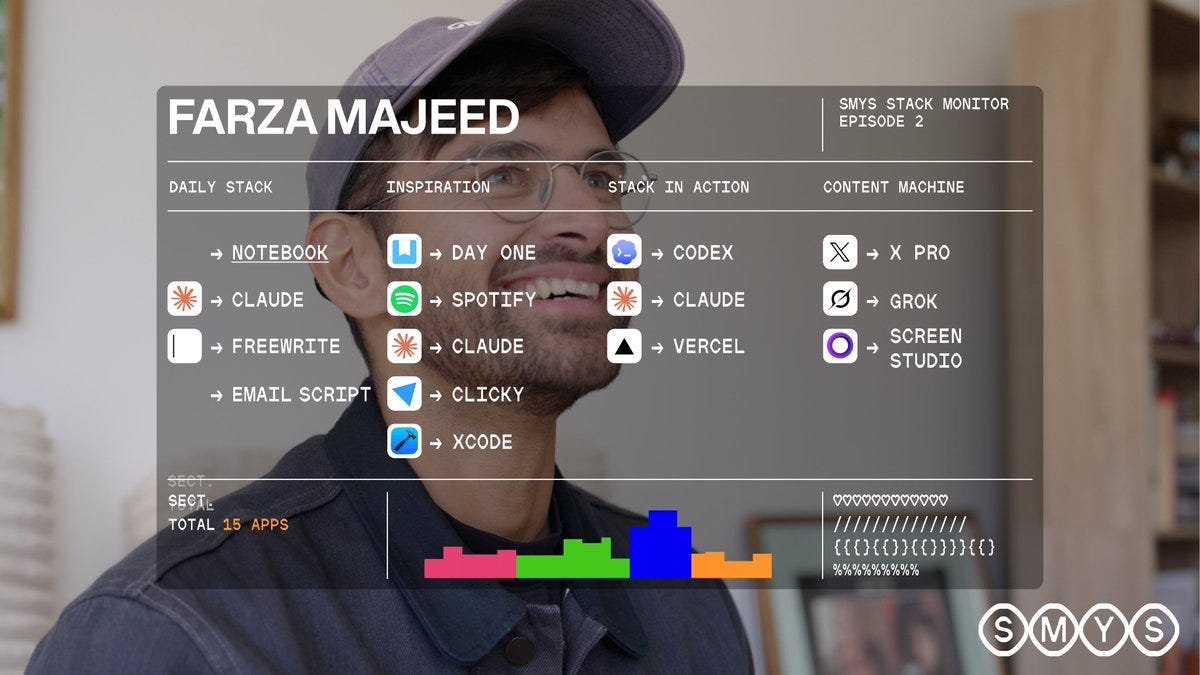
If you’re like me and you’ve found yourself nosing around someone’s home screen during a screen share, like I often do, and take a sly screenshot and reverse image search the app logo, this series is for you. Could just be me though…..
Julia Rosenberg has launched a new video series called ‘Show Me Your Stack’ - a 6-episode series where she sits down with some of the most prolific builders on the internet and gets them to walk through their actual digital workflows. Not a curated list of tools for a sponsored blog post, but a genuine screen tour, consisting of what they open first thing in the morning, how they capture ideas, which AI agents they’ve stitched together, and the weird rituals that make it all work.
Season 1’s guest list is strong: Farza (who built Clicky — featured below), Charlie Holtz, Alana Goyal, Guillermo Rauch (Vercel CEO), Shiv Bagavathy, and Sam Hogan.
Two episodes are already live — including Shiv, who famously rebuilt a $610M app in a weekend, and Farza, whose episode is a masterclass in blending analogue habits with AI-powered workflows.
📓 Articles
The man who is paying to see the future
There is no doubt that personal AI agent assistants will be as synonymous as smartphones in the future. AI assistants aren’t a new concept - but their abilities have been limited until now. However, despite these recent advancements with agents, there is still a lot of progress to be made. Powerful models and agents are expensive, they are fiddly to configure for even the most technical of us, and safety is a big concern.
But what if you had the skills, the time, and the money? What could you actually build?
Well, Bill Nguyen has all of the above. He’s a serial tech founder with 3 exits under his belt, two of which to Apple, and he’s on a mission to build a proxy of himself — not just a chatbot or assistant, but a virtual body double that can make decisions and take actions on his behalf.
“I didn’t ask it to help me,” Nguyen said. “I asked it to be me.”
To give you an idea of the extent of control he’s passed to his agents, his AI has permission to email people on his behalf, and sometimes sets up in-person meetings with people he has never met. It has his bank account details and makes purchases, holidays and gifts sometimes without his knowing.
Nguyen is part of an ever-growing clan of token-maxxing power users who are throwing tens of thousands of dollars to push the limits of agent capabilities in an effort to outsource as many of their mundane and time-consuming tasks.
In this post, Reed Albergotti explores Bill’s attempt to create a digital AI clone of himself.
🆕 Products
Cursor for hardware
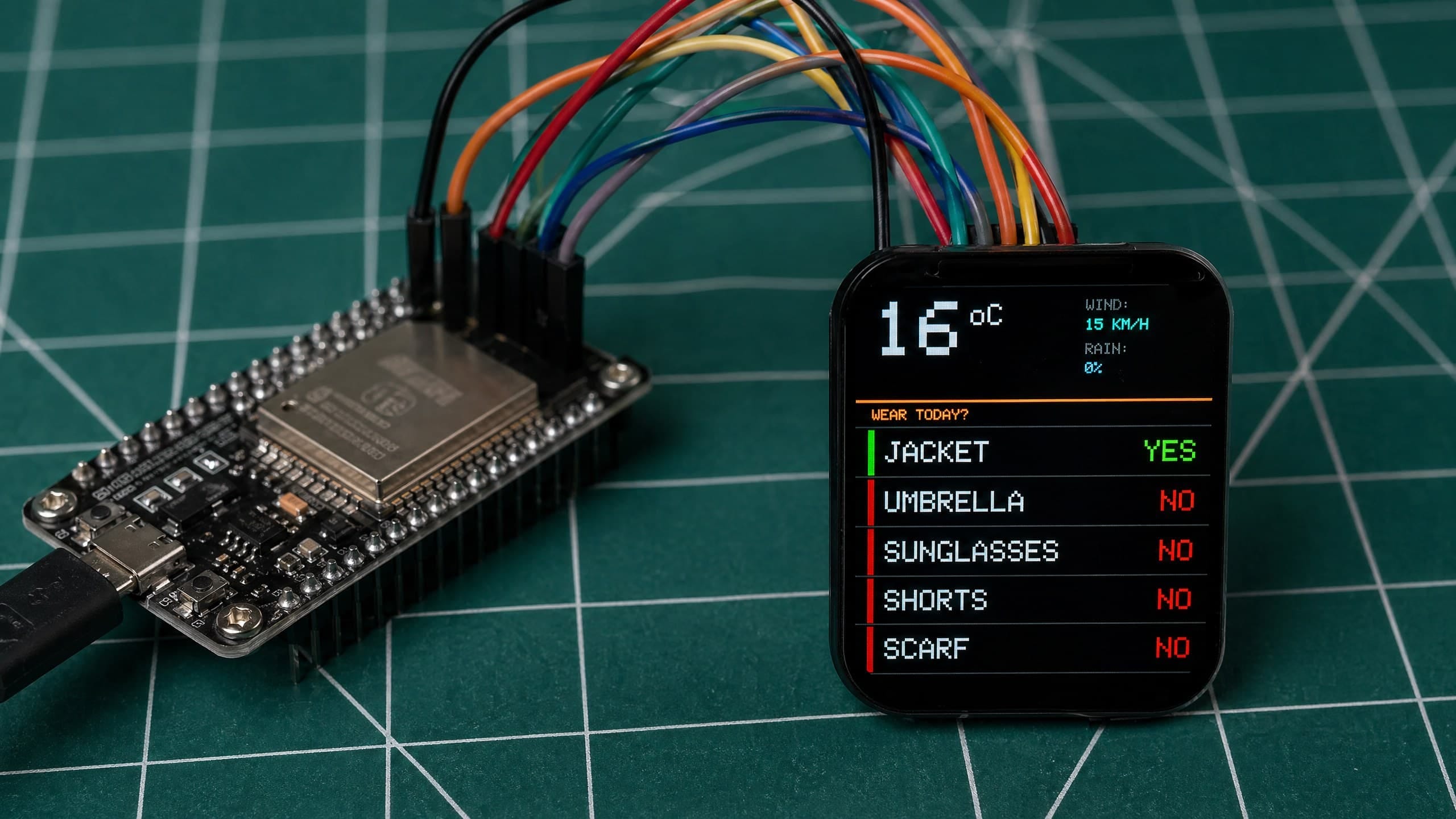
In keeping with the unintentional theme of hardware in this issue, we have a new startup from an internet friend of mine Sam Beek (ex-Veed CPO), called Schematik, which just raised a generous pre-seed round of $4.6M.
Think of Schematik as a vibe coding platform for programming microcontrollers. You describe what you want in natural language, and it generates everything: firmware code, wiring diagrams, and step-by-step assembly instructions.
Over the past years, tools like Lovable and Claude Code have completely changed how we build software and lowered the barrier so that anyone can create software. But building hardware is still really hard. Schematik solves that — you describe what you want to build, and it gives you the code, wiring diagrams, component list, and assembly instructions to make it work.
I, for one, will be attempting to build something similar to the picture above, which will show me when it’s ideal kite surfing weather. And if you're interested, the hardware you need for something like this only costs about £18, which is super cheap.
With AI increasingly getting better at creating software, it makes me think - is hardware the next startup frontier with more opportunities?
Clicky | AI buddy that lives on your Mac
Farza is back at it again, and this time he’s got a new…..wait for it…..yup, an AI product of course. But this isn’t a new lab, an AI-enabled CRM, AI writing assistant, blah blah blah - instead it’s a fun persistent Mac AI assistant which sees everything your cursor can. While a lot of the AI products sit in your browser or siloed in an app, Clicky sits at the OS level and, therefore, makes it more capable. To interact with it, you hit a keyboard shortcut and ask Clicky a question or get it to perform an action, and it will spin up an agent.
I was extremely impressed with the onboarding flow. Anyone creating a Mac app needs to check this out. They have really found some incredible hacks which I can’t figure out how they achieved.
The app itself takes a little getting used to - especially if you're not used to verbally instructing an AI. For me, I kept forgetting the trigger word to get the agent to work, but after a few days, it became second nature. There is some work to tweak the quality of the output, but it’s only been launched for a few weeks, and their feedback and iteration loop is so tight I’m seeing improvements daily.
Star | The loudest way to raise money on the internet
Imagine if Twitch, Kickstarter and the NASDAQ had a baby. That’s apparently this - a fundraising platform where founders raise capital through live, public token sales.
But here’s the fun part. They run a weekly live shark tank. You pitch to a live audience and a panel of sharks, and curators trade in a market to decide who wins. The winner gets a 24-hour raise window with all the platform’s capital and attention behind them.
While I’m a token sceptic, I’ll still be tuning into the next livestream. And if you’ve got a second, check out this brilliant hype video!
🐽 Other links to consume
Search, analyse, and discover insights from Y Combinator's portfolio
An interactive guide to understanding AI from first principles
If you made it this far, hit reply or jump into the comments and tell me what you thought of this edition. Was this 🔥 or 🗑? I read every response 👀
Until the next issue,
Sam | @thisdickie 👨💻