
The world is short software
The thinking game | Inside Cursor | How to make something great | The DIY software movement | New software products + loads more…

🆕 Personal Updates
This is the last issue of 2025. As always, I’ll be taking some time off with the family and setting aside time to reflect and plan next year’s goals.
As ever, a huge thanks to everyone who reads the newsletter and reaches out each month.
To all those who celebrate it, have a fantastic Christmas and New Year when the time comes.
Right, let’s get to it - time for this month’s roundup 👇
🔥 Last edition’s top clicked link: Why our website looks like an operating system
🔗 Hyperlinks
The Thinking Game
I love a documentary, especially a nerdy one like this. Better still, it’s free. The Google documentary takes you on a journey into the heart of Google’s AI lab - DeepMind, capturing a team and its founder striving to unravel the mysteries of intelligence and life itself. Sounds pretty great, right?
Filmed over five years by the team behind AlphaGo, the documentary examines how Demis Hassabis’s extraordinary beginnings shaped his lifelong pursuit of artificial general intelligence. It documents how the team moved from mastering complex strategy games to the ups and downs of solving a 50-year-old “protein folding problem” with AlphaFold, and finally, the acquisition by Google and the company’s future ambitions.
One things for sure, after watching this doc it’s hard to bet against Google dominating the AI race if Demis is still at the helm of their AI lab.
Fun fact: the lore behind the model’s name, ‘Gemini’, comes from the Gemini zodiac constellation. This constellation is related to its adaptability and a dual nature. The dual aspect of the name is due to the merging of two AI labs, DeepMind and Google Brain.
📓 Articles
Inside Cursor
Brie Wolfson provides a rare insight into one of Silicon Valley’s fastest-growing AI startups - Cursor, after spending almost two months working with them.
Cursor was one of the fastest-growing startups in history, having achieved $100M in just 12 months with just 12 people and no sales team. The company has since been through a hiring spree, but despite their revenue, they still have a considerably low headcount and somewhat a-typical culture and working environment.
As one very early document on Cursor’s culture noted, “Cursor probably ranks the highest in the world in terms of the average number of hours using the company’s main product per employee per week. The only real contender might be Apple with their Macs and iPhones.” This dogfooding culture can only create an unfair advantage.
One particular interesting observation which Brie shared that keeps popping into my head:
….the creative process are on full display, and what’s so beautiful about the whole thing is we’re reminded that, when it comes to making something wonderful, the magic is in the mundane. Greatness is created through the collision of little sparks, ignited by people at the peak of the craft who care a lot and won’t stop working until it gets there.
🎁 Bonus content: After having thoroughly enjoyed the Cursor article, I explored the publication Colossus and stumbled upon this great post titled ‘The Amusement Park for Engineers’, exploring a rare behind-the-scenes insight into Andrill’s workshops.
🎁 Bonus bonus content: Linear founder, Karri Saarinen recently kicked off a hot debate on X after quote-tweeting the launch of Cursors’ new visual design interface with a post, expressing his scepticism of designing with code broadly in short suggesting AI tools can be great for validating or prototyping the design explorations, but miss the messy middle of iteration and refinement without touching a line of code. So it’s part of the process but not the whole process.
How to make something great
While we are on the topic of Cursor, spoil yourself with this fantastic short essay by Ryo Lu (Head of Design at Cursor), which provides his personal advice on creating something great.
Personally, I found it a delightful reminder that it’s a messy process creating anything of value and that the process itself is also ambiguous at times. As one reader of the essay put it, it’s as if “The creative act” by Rick Rubin and “Make something beautiful” by Steve Jobs had a child in the form of an essay.
Ryo suggests beginning with fertile but fuzzy ideas and avoiding over-defining them too soon in the process. Recruiting true believers, not title-chasers and keeping the aperture wide early to discover unexpected connections, before narrowing down later.
In addition, try to resist smothering newborn ideas with premature validation; let them stand before you test. Hold two gears at once: agility and excellence, and layer meaningful increments until the whole feels inevitable.
Forward progress is made when you trust the raw feeling that something is worth trying and then try it.
Bottom line - greatness is an iterative grind. With the mindsets, methods, and taste aligning until the risky bet looks obvious in hindsight.
The future of the web is the history of YouTube
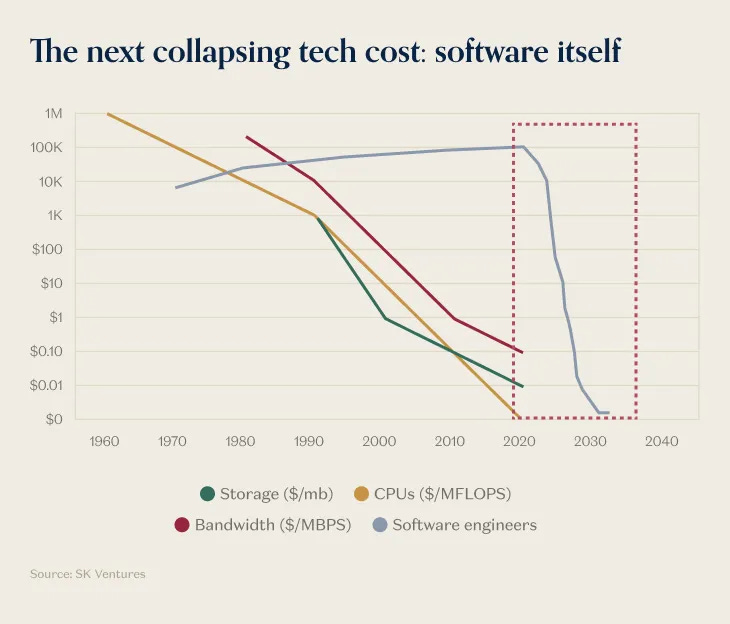
The title of the post initially threw me, but it’s actually a fantastic analogy to grasp with respect to how AI is going to disrupt the creation of software, just like YouTube did in creating content online.
The world is short software
This statement is somewhat contrarian these days. The general sentiment has been that there is too much software. There are apps for everything, more websites than human beings multiple times over and hundreds of new b2b, b2c, b2b2c software products launching daily. Yet, what if we flip that sentiment on its head and consider for a moment that there isn’t enough software? What if we world needs more software, but instead of purchasing more generic software, we create it ourselves based on our or the market’s unique needs?
The web has always been great at facilitating permissionless creation by anyone. But it wasn’t until LLMs that the definition of “anyone” changed from “developers” to “literally anyone with an idea and access to a coding agent.”
This promise of democratised software was previously promised with the advent of no-code tools, but it didn’t come to fruition for various reasons; perhaps this new advancement with AI will. Is this the YouTube moment for software?
📱 Products
Google AI Studio
This month, I’ve been playing around with Google’s much-improved Vibe coding platform - AI Studio. I’ve been building a couple of small personal apps initially just to test the capabilities; however, the output has been so good that I’ve been using these mini tools daily and continuing to create more.
Firstly, I created an app which allows me to log all the repairs I need for my 120-year-old property. I capture images and add a title, and let my app log the issues and automatically assess the priority, provide a detailed description of the issue, provide a rough cost estimation for the repair work and recommend local contractors with high Google review ratings.
Next up, I’ve got an app which tracks all my subscriptions and insurances. The app monitors the price I’m paying now and adds an iCal reminder a month before the renewal date.
Lastly, I’m in the process of creating a newsletter reader to replace the recently shut-down Stoop Inbox. Think something similar to Meco, but stripped back with an email address and RSS to collate newsletters and blog content.
These new AI vibe coding tools have promised a new wave of DIY products for some time; personally, I think we have finally made it possible for most to create basic personalised apps to replace a number of expensive, bloated, one‑size‑fits‑all tools.
What will you build?
🎁 Bonus content: There are two new startups looking to take advantage of the DIY software movement, all from your mobile device. Anything and Wabi. I’m currently testing out Anything and still waiting on my Wabi invite. I’ll report back soon.
Shutter Declutter | Free up space
An odd holiday ritual of mine on flights is to tidy my photo library. Why do I feel so compelled to undertake this tedious task while flying? I have no idea. So when I discovered Shutter Declutter from a recommendation via Dense Discovery, I decided to give it a shot to speed up my photo cleansing process. A few days later, and i managed to erase 3,095 photos, saving me 7.39GB on my device and iCloud.
Existence | The time intelligence platform
A while back (May 2024), I featured an insane time scheduling system created by Rob Dyrdek’s which he developed to log every second of his day. A few years on, it looks like he’s productised it and is launching a new SaaS product targeting serious time management nerds.
Existence is a Time Intelligence platform that allows you to fully account for all dimensions of your time and turn that data into actionable insights, helping you identify trends and optimize overall quality of life.
With 2.4m followers of X alone, distribution might not be a challenge; however, I do wonder the extent of the TAM for such an extensive productivity tool.
🆕 Products
Eigen Industries: AI companions.
Pablo: the AI agent that designs and optimises your website itself.
Slane: an intelligent workspace that helps teams plan projects.
Tavus: AI-powered digital human beings
🐽 Other links to consume
If you made it this far, hit reply or jump into the comments and tell me what you thought of this edition. Was this 🔥 or 🗑. I read every response 👀
🚀 Advertise on this newsletter to get in front of 9,000+ curious minds
💬 Need some advice on building products. Grab some time with me.
🧪 Looking to validate an idea for a new business or side project? Check this out
If you liked this issue and fancy some free goodies, consider referring someone to the newsletter and get rewarded for doing so.
Until the next issue,
Sam | @thisdickie 👨💻
🎯
> The general sentiment has been that there is too much software. There are apps for everything, more websites than human beings multiple times over and hundreds of new b2b, b2c, b2b2c software products launching daily. Yet, what if we flip that sentiment on its head and consider for a moment that there isn’t enough software? What if we world needs more software, but instead of purchasing more generic software, we create it ourselves based on our or the market’s unique needs?